Garage door maintenance in Brunswick is a discipline that returns more value per visit than in newer suburban garages because the doors and structures being maintained are older and operating in more demanding conditions. Brunswick’s Victorian terrace conversions and inter-war weatherboard bungalows carry garage door systems that may have been in service for decades, operating in Melbourne’s inner north weather and the dusty, gritty environment of Brunswick’s back laneways.
Garage door maintenance in Brunswick for these homes is not simply about keeping a modern mechanism running smoothly — it is about extending the service life of older systems, identifying problems before they become failures, and ensuring that the structural elements supporting the door mechanism are as sound as the mechanism itself.
Melbourne’s inner north weather and its effect on Brunswick garage doors
Melbourne’s weather creates specific maintenance demands for garage door systems across all suburbs, but Brunswick’s inner north position creates a particular combination of conditions. The suburb is not on the coast, so it does not receive the concentrated salt air that affects Albert Park’s bayside garages.
But it does experience Melbourne’s full seasonal range — cold, wet winters with frequent rain and condensation; hot, dry summers with occasional extreme heat events; and the rapid temperature swings of Melbourne’s spring and autumn that cycle metal components through expansion and contraction repeatedly.
Brunswick’s laneways add to this weather exposure. Back lanes in inner Melbourne are not sealed and drained to the standard of main roads — they accumulate grit, leaf debris, and moisture that is kicked up by passing vehicles and carried by rain into the garage door mechanism. The lower sections of a roller door guide rail in a Brunswick back lane, and the pivot hardware on a tilt door at lane level, receive more contamination than the equivalent components in a sheltered suburban driveway garage.
The annual maintenance checklist for Brunswick garage doors
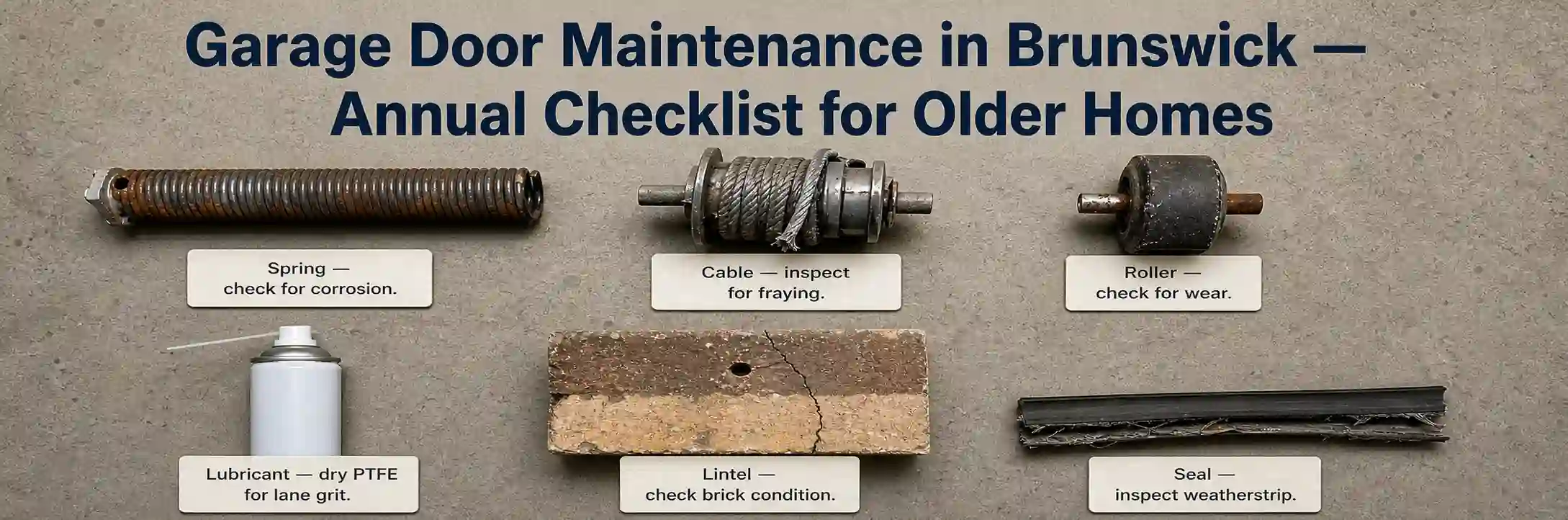
Garage door maintenance in Brunswick covers both the door mechanism and the structural elements that support it:
- Spring inspection and lubrication — inspect all springs for rust, corrosion, or visible deformation. For tilt doors: check the counterbalance spring tension by manually testing the door balance. For roller doors: inspect the torsion spring above the door for any rust development or visible gap. Lubricate all springs with a corrosion-inhibiting spray — not a standard oil that attracts dust, but a dry PTFE lubricant or specific garage door spring lubricant that protects the metal without collecting the lane debris.
- Cable and drum inspection — check all cables for fraying, rust, or wear at the connection points. Cables in Brunswick’s lane environment accumulate grit in the strands, which accelerates wear and should be cleaned during the maintenance visit. Cable drums should be free of corrosion and the cable should be evenly wound on the drum without crossing.
- Roller and hinge inspection — for roller doors: check the guide rail rollers for wear or flat spots. A roller that is no longer round will cause vibration and noise as the door travels. For tilt doors: check the pivot hardware and hinge points for wear and correct alignment.
- Lintel and structural check — in Brunswick’s older garage conversions, inspect the lintel above the opening and the brickwork in the immediate vicinity of the door track mountings. Cracks around the opening that were not present at the last inspection should be investigated further before the maintenance is considered complete.
- Automatic opener test — test the safety reversal function by placing a solid object under the door and triggering the close cycle. The door should reverse when it contacts the object. Also test the manual release cord and confirm that the door can be operated manually in the event of a power failure.
- Frame and weatherseal inspection — check the door frame for any timber rot or moisture damage at the base and at the fixing points for the door hardware. Inspect the bottom seal on roller and sectional doors for damage or deterioration that allows water or draught entry.
Inter-war bungalow specific maintenance in Brunswick
Garage door maintenance in Brunswick for inter-war bungalow properties has specific considerations from the weatherboard construction that characterises many of these homes. Weatherboard garages or carport structures adjacent to the main bungalow are particularly susceptible to moisture-related deterioration at the timber elements that carry the garage door hardware. The maintenance visit for a weatherboard Brunswick garage should include:
- Checking the paint or stain condition on all timber elements of the garage structure — any bare or peeling sections should be retreated before the next wet season to prevent moisture penetration
- Inspecting the base of all timber wall frames and door frames for rot or moisture damage at ground level, where the most exposure occurs
- Checking the fixings that hold the door track or pivot hardware into the timber frame — in a weatherboard structure, the fixing integrity depends on the condition of the timber the fastener is in, and a fastener that is pulling loose from deteriorated timber is a structural failure waiting to happen
Seasonal timing for Brunswick garage door maintenance
Garage door maintenance in Brunswick is most effective when timed to the suburb’s seasonal conditions. The most practical timing is autumn — after Melbourne’s summer heat and dust have accumulated on all surfaces, and before the wet winter conditions arrive that increase moisture exposure across the mechanism. An autumn maintenance visit cleans off the summer accumulation, lubricates all metal parts before the cold and wet conditions that slow mechanism operation, and identifies any components that are approaching failure before the winter period of regular use.
A secondary service visit in spring — after winter — is worthwhile for Brunswick properties with older systems or where the annual maintenance has consistently found issues that warrant more frequent monitoring. Spring maintenance addresses any corrosion that developed over the wet winter months, checks the door balance after the temperature cycling of the cooler months, and prepares the mechanism for summer’s heat and increased use.
When Brunswick garage door maintenance reveals a bigger issue
Garage door maintenance in Brunswick sometimes reveals issues that go beyond the mechanism and into the structure of the garage itself. In an older Brunswick terrace conversion, the maintenance visit is often the first time a qualified tradesperson has closely inspected the structure for several years.
Finding a lintel crack that has widened since the previous visit, discovering timber rot at the base of a weatherboard frame, or identifying brickwork movement near a tilt door pivot point are all discoveries that a maintenance visit is ideally placed to make before these structural issues cause a door failure or require expensive emergency work.
When a maintenance visit in Brunswick reveals a structural issue beyond the mechanism, the appropriate response is a clear written report of what was found, what the risk implication is, and what the recommended remediation involves. A technician who simply notes a crack and carries on with the lubrication without documenting the finding is not delivering the full value of a maintenance visit.
A written maintenance report that includes structural observations as well as mechanism condition findings gives the Brunswick homeowner the information they need to decide whether further investigation by a structural specialist is warranted before the next visit.
Garage door maintenance in Brunswick is worth prioritising because the older garage conversions and heritage outbuildings that make up so much of the suburb’s garage stock have more to benefit from regular maintenance than a new suburban door installed in a controlled environment.
Annual autumn maintenance, supplemented by spring checks for higher-risk systems, and extended to cover the structural elements of older Brunswick conversions as well as the mechanism, delivers the full value of the maintenance investment and keeps Brunswick’s diverse and historically significant garage stock in reliable service.
Conclusion
Garage door maintenance in Brunswick for the suburb’s Victorian terrace conversions and inter-war weatherboard bungalows is a structural and mechanical discipline, not simply a mechanism service. The lintel check, the frame inspection, the spring condition assessment, and the lubrication appropriate to the lane environment combine with the standard mechanical checks to produce a maintenance visit that genuinely protects an older Brunswick garage from unplanned failures. Annual autumn timing, supplemented by a spring visit for older or higher-risk systems, is the maintenance cadence that keeps Brunswick’s diverse garage door stock operating reliably through Melbourne’s seasons.