
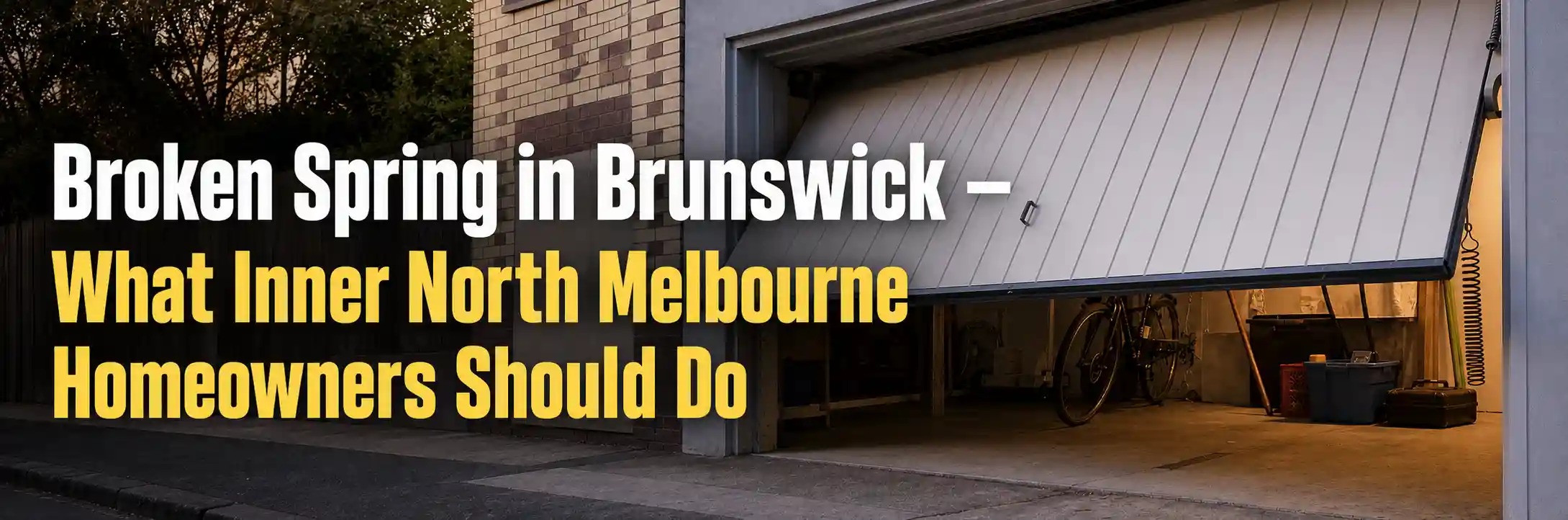
A broken garage door spring in Brunswick is a common emergency in a suburb where the garage door systems in many properties date from the 1980s, 1990s, or earlier and have accumulated the operating cycles and environmental exposure that eventually lead to spring failure.
Brunswick’s inner north Melbourne location, the laneways that carry grime and Melbourne’s variable weather to the garage door mechanisms in the suburb’s terrace conversions, and the relatively modest maintenance attention that older Brunswick garage conversions have typically received combine to create conditions where springs fail more frequently than in newer suburban garages. A broken garage door spring in Brunswick is not unusual — but knowing how to respond correctly determines whether the situation is resolved quickly and safely or becomes a more disruptive problem.
The specific spring failure risks in Brunswick’s older garages
Springs in Brunswick garages fail for the same fundamental reasons they fail anywhere: they reach the end of their designed cycle life, they develop corrosion that weakens the metal faster than normal wear would, or they were not correctly specified for the door weight when they were originally installed. In Brunswick’s older garage conversions, however, there are specific factors that accelerate these failure causes.
The lane environment in Brunswick — grit, dust from the road surface, debris from overhanging trees, and the moisture from Melbourne’s wet winters — creates a more abrasive and corrosive environment for springs than a sheltered suburban garage. Springs in Brunswick laneways that are not regularly lubricated accumulate surface rust and corrosion that weakens the metal cross-section and brings forward the failure point. Many Brunswick garage doors have not been serviced in years, making a spring failure that could have been identified and prevented by a maintenance visit instead a sudden event.
Brunswick also has a significant number of tilt doors alongside its roller doors, and tilt door spring systems behave differently from the torsion spring systems used in roller and sectional doors. A tilt door uses a pair of extension or coil springs mounted on either side of the door opening to counterbalance the door’s weight through its pivot motion. When a tilt door spring fails, the door may drop suddenly on the failed spring side, creating a one-sided hanging door that is potentially dangerous if it falls further.
What happens when a spring fails in a Brunswick garage
Depending on the door type and the stage of failure, a broken spring in Brunswick produces different symptoms:
- Tilt door — sudden drop on one side: If one of the two side springs on a tilt door fails while the door is in operation, the door may drop sharply on the failed spring side. If the failure occurs while the door is in motion, the door can swing or fall unpredictably. A tilt door that feels unbalanced — heavier on one side than the other during manual operation — may have a spring that is near failure and should be inspected.
- Roller door — door feels very heavy or will not open: A roller door spring failure produces the same symptoms as in any other suburb: the door feels extremely heavy to lift manually, the automatic opener strains or disconnects, and the door typically cannot be raised. The loud snap of the breaking spring may have been the first sign noticed.
- Door stuck in open position in a Brunswick lane: A spring failure with the door in the open position leaves the lane-access garage open and unsecurable in an inner north Melbourne back lane used by multiple properties. This is a more urgent security situation in a Brunswick back lane, where the lane is a shared access way for multiple properties and their residents.
Immediate steps for a broken spring in Brunswick
- Stop operating the door immediately — disconnect the automatic opener if fitted by pulling the emergency release cord.
- Assess whether the door is in the open or closed position. If open in a Brunswick back lane, the security priority is to assess what is in the garage and whether the internal access door from the garage to the home is in place and can be locked.
- Do not attempt to manually operate the door or force it to close. A tilt door with a failed spring is particularly unpredictable in how it may move if further force is applied.
- Call a Brunswick-experienced garage door technician. Provide the door type — tilt or roller — and whether the door is stuck open or closed. For a tilt door, mention that it is a tilt system, as the spring specification and replacement approach differs from roller door spring work.
Tilt door spring replacement vs roller door spring replacement in Brunswick
Brunswick’s mix of tilt and roller doors means that a spring replacement call in the suburb might involve either spring system, and the correct response for each differs:
- Tilt door springs: Tilt door springs in Brunswick are typically extension or coil springs mounted on the wall or ceiling beside the door opening, or counterbalance springs integrated into the pivot hardware. Replacement involves releasing the remaining tension safely, removing the failed spring, and installing a correctly matched replacement. The counterbalance geometry of a tilt door is less adjustable than a roller door torsion spring system, so the replacement spring must closely match the original specification.
- Roller door torsion springs: Standard torsion spring replacement procedure applies — release tension, remove and measure the failed spring, install a matched or upgraded replacement, wind to the correct tension, and test the door balance. Both springs should be replaced simultaneously if the door has two.
Preventing the next spring failure in Brunswick
A broken garage door spring in Brunswick is largely preventable with regular maintenance. An annual inspection that includes checking spring condition — looking for rust, corrosion, or visible deformation in the coil — and lubrication of all metal components significantly extends spring service life. In Brunswick’s lane environment, where dust and moisture contact is higher than in a sheltered suburban garage, a six-monthly lubrication is more appropriate than annual for properties in lanes with significant traffic or tree coverage.
The Sydney Road context and Brunswick spring replacement urgency
Brunswick’s position as an inner north suburb with Sydney Road as its main commercial spine and a dense residential population in the streets behind it creates a specific urgency context for spring failures that leave garage doors open in back lanes. Brunswick’s lanes are busier than the lanes in a quieter outer suburb — they serve a larger number of households per lane length, are used more frequently by residents on foot and bicycle as well as by service vehicles, and are in some sections poorly lit at night.
A Brunswick garage stuck open in a back lane is in a more active shared-access environment than a similar situation in a quieter suburb, making the urgency of the repair proportionately greater.
When calling for a Brunswick spring replacement, be specific about the lane location. Brunswick’s lanes are not always clearly signed, and providing the street addresses on both sides of the lane at the nearest cross street, or the lane’s local name if it has one, helps the technician navigate directly to the property without driving around the block to find the correct lane entry. This specificity reduces the arrival time, which for a spring failure leaving a garage open in a Brunswick back lane is a direct security benefit.
A broken garage door spring in Brunswick is resolved fastest by a technician who knows both tilt and roller door spring systems and who is familiar with Brunswick’s lane access configuration. The preparation that makes the response fastest — the technician’s number already saved, the door type and lane location already noted — is available to every Brunswick homeowner before the spring fails. The five minutes spent making that preparation is the most effective investment in a fast spring failure resolution.
Conclusion
A broken garage door spring in Brunswick requires immediate stop-use, a call to a technician with Brunswick tilt and roller door experience, and a replacement approach that specifies the correct spring type for the specific door system. Brunswick’s mix of tilt doors and roller doors, the lane-access environment, and the older garage conversion stock that characterises much of the suburb make spring replacement in Brunswick a job for a technician who knows both spring systems and the inner north Melbourne context in which they operate.