
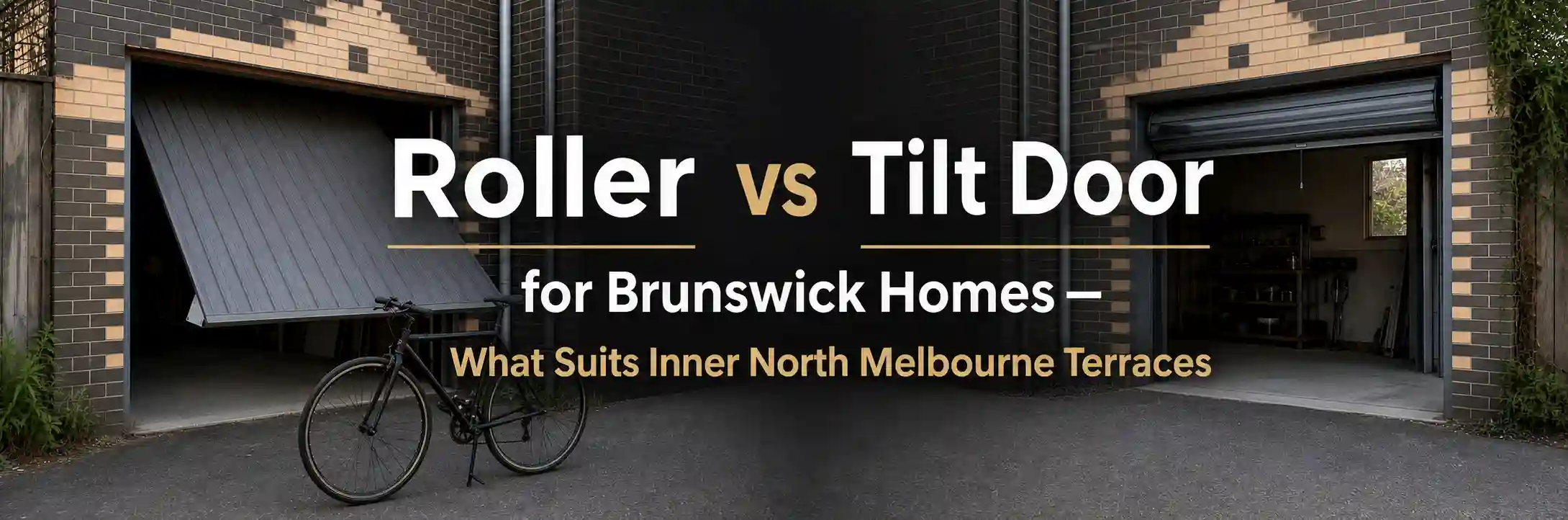
Roller vs tilt door for Brunswick is a more relevant comparison than it is in most other inner Melbourne suburbs. While Richmond’s back lanes are overwhelmingly served by roller doors, and Toorak’s prestige homes have largely transitioned to sectional doors, Brunswick retains a significant number of tilt doors in its terrace conversions and older garage structures.
These tilt doors were fitted to Brunswick garages from the 1960s through to the 1990s as a practical, lower-cost alternative to roller doors for narrow lane openings, and many are still in service today — some operating normally, others in need of replacement. The roller vs tilt door comparison in Brunswick is therefore a live decision for homeowners replacing an existing tilt door, not just an academic comparison between two new installation options.
How tilt doors work and where they still exist in Brunswick
A tilt door operates on a horizontal pivot axis — the bottom of the door swings outward toward the lane as the door opens, then the whole door panel tilts upward and rests in a roughly horizontal position inside the garage opening when fully open. This operation requires a clearance arc in front of the door opening — the space into which the bottom of the door panel swings before tilting up. In a narrow Brunswick lane where another vehicle might be present during the opening cycle, this swing arc is a constraint that roller doors do not share.
Tilt doors in Brunswick are typically found in two configurations. The first is the original installation — a single panel tilt door in a converted outbuilding opening, fitted to a lane-facing garage that was converted to vehicle storage at some point from the 1960s to the 1990s. The second is a tilt door that was installed as a replacement for an even older door type, typically a set of inward-swinging timber panel doors that were the original conversion approach for some Brunswick outbuildings.
The tilt doors still in service in Brunswick are in various conditions. Some have been well-maintained and continue to operate reliably. Others show the signs of aged counterbalance springs — doors that require extra lift assistance to open, doors that do not stay in the open position without support, or doors that close more quickly than they should because the counterbalance spring tension has reduced over time.
The case for replacing a Brunswick tilt door with a roller door
Roller vs tilt door for Brunswick in the context of a tilt door that needs replacement points toward the roller door in most cases. The reasons are specific to the Brunswick lane environment and the heritage planning context:
- ● No swing arc in the lane — a roller door travels straight up, with no forward swing into the lane during the opening cycle. In a narrow Brunswick back lane where other residents’ vehicles, cyclists, or pedestrians may be present, the absence of a swing arc makes the roller door a safer and more practically convenient choice. A vehicle can remain positioned in the lane as close to the garage as needed — the roller door will not swing into it as it opens.
- ● Simpler mechanism — a roller door mechanism is mechanically simpler than a tilt door mechanism, with fewer moving parts and a more straightforward failure mode. Parts availability for old tilt door hardware can be an issue as the product category has declined in popularity — some Brunswick tilt doors use pivot hardware and counterbalance springs that are difficult to source for replacements.
- ● Heritage overlay compatibility — a compact roller door in a heritage-compatible colour presents a low-profile appearance from the lane that is typically straightforward to approve under the Merri-bek heritage overlay provisions. A tilt door, which has a more prominent swing into the lane space, does not offer a heritage planning advantage over a roller door for lane-facing heritage properties in Brunswick.
When a tilt door might still be the right choice in Brunswick
Roller vs tilt door for Brunswick has a small number of situations where the tilt door remains appropriate:
- ● Street-facing garages with setback driveways — for the minority of Brunswick properties where the garage faces the street rather than the lane, and where there is sufficient driveway setback for the tilt door’s swing arc to operate safely, a tilt door can still be installed where the homeowner prefers the aesthetic or where matching an existing door on a multi-door garage is the priority
- ● Heritage properties where like-for-like replacement is the planning preference — if the existing door is a tilt door and the heritage overlay planning context favours a like-for-like replacement, retaining the tilt door type as the replacement choice is the lowest-risk planning path. A like-for-like tilt door replacement avoids the planning permit process that a change to roller door might require for some heritage properties
- ● Low-ceiling garages where the roller door drum cannot fit — the roller door drum housing requires headroom above the door opening. In a Brunswick converted outbuilding with a very low ceiling, the available headroom may not accommodate the drum. In this specific situation, a tilt door — which requires no overhead drum space — may be the only practical choice
Making the decision for a Brunswick terrace conversion
Roller vs tilt door for Brunswick for a specific property comes down to four practical checks:
- Measure the lane clearance — is there enough clear space in front of the garage opening for the tilt door’s swing arc to operate safely? If the lane is very narrow or if another structure or fence is immediately in front of the opening, the roller door is the practical choice.
- Measure the headroom inside the garage — is there sufficient clearance above the door opening for a roller door drum housing? A minimum of 150 to 200 millimetres above the opening height is typically required for standard drum configurations.
- Check the Heritage Overlay status — is the property within a Merri-bek Heritage Overlay? If so, is the existing door a tilt door, and would changing to a roller door require a planning permit? A pre-application enquiry to Merri-bek City planning confirms this before any decision is made.
- Assess the existing tilt door’s condition — if the existing tilt door is being replaced because it has worn out, the replacement tilt door parts availability should be confirmed before committing to a like-for-like replacement. If the parts are readily available, a like-for-like tilt door replacement may be straightforward. If parts are difficult to source, the transition to a roller door is more practical.
Automating the replacement decision — roller door openers in Brunswick lanes
Roller vs tilt door for Brunswick in the context of automation: when a tilt door is being replaced and the homeowner is considering adding an automated opener, the choice of door type has a direct impact on the automation options available.
Tilt door automation systems exist — they use a ceiling-mounted arm that attaches to the tilt door panel and drives the opening and closing cycle — but they are less widely supported in Australia than roller door automation systems, and the product range of tilt door openers is much narrower than for roller doors. If automation is a priority for the replacement installation, the roller door is significantly more practical.
A roller door with a quality tubular motor is the standard automated installation for Brunswick back lane garages. The tubular motor sits inside the coil drum and is invisible from the lane when the door is installed, which is an advantage for the heritage visual presentation as well as for the weathering protection of the motor unit.
Remote control and smartphone app connectivity are standard features in current-generation tubular motors, and the product range of these systems covers the full range of Brunswick garage opening dimensions without the sizing constraints that can affect some tilt door automation products.
Roller vs tilt door for Brunswick is a practical decision that most Brunswick homeowners with existing tilt doors will face at some point as those doors age out of reliable service. The answer in most Brunswick back lane situations is the roller door — for its lane clearance advantage, its parts availability, its automation compatibility, and its heritage planning compatibility. The specific minority situations where a tilt door remains the right answer are real but not the typical Brunswick conversion configuration that most homeowners will encounter.
Conclusion
Roller vs tilt door for Brunswick is a genuine and current decision for inner north Melbourne homeowners whose older terrace conversions still have tilt doors in service. In the majority of cases, a roller door replacement offers practical advantages over a tilt door — no swing arc in the lane, simpler mechanism, better parts availability, and straightforward heritage overlay compatibility. The minority of Brunswick situations where a tilt door remains appropriate — low-ceiling garages, street-facing setback driveways, or specific heritage like-for-like planning situations — are real but not the typical Brunswick terrace conversion configuration.